 Stormproof
In this article
Key takeaways
- Meltdowns are not a sign of bad parenting or a "bad kid." Outbursts aren't an official ADHD symptom, but they're very common in children with ADHD because of impulsivity and difficulty handling strong feelings.
- In the moment, your job is safety and calm, not teaching. Reasoning with a child mid-meltdown doesn't work.
- Learning happens afterward, when everyone is calm: repair, reflect briefly, and practice.
- Most meltdowns follow predictable triggers. Changing the trigger is often more effective than changing the reaction.
- If your child becomes physically aggressive, safety comes first. Frequent or frightening outbursts are a reason to get professional help, and parent training is one of the most effective options.
It started with something tiny. The wrong cup. The iPad battery at 2%. "Time to get in the car." Thirty seconds later, your child is screaming, kicking the door, maybe throwing things or hitting you, and you're standing there wondering how this happened again.
If you're searching for help with an ADHD meltdown, you're probably exhausted, maybe embarrassed, and possibly scared. Let's start with something important: this is not your fault, and it's not because your child is bad. It's a brain that gets flooded faster and calms down slower than other brains. And there's a lot you can do.
Why kids with ADHD melt down
The Child Mind Institute notes that while emotional outbursts and defiance aren't official symptoms of ADHD, more than half of kids with ADHD show them, largely because of impulsivity and difficulty managing strong emotions.
In everyday terms, a child with ADHD often has:
- A short fuse: the feeling arrives instantly and at full volume
- Weak brakes: the pause between feeling and action is very short
- Trouble switching: stopping something fun is genuinely painful
- A full tank: after a day of trying hard to sit still, listen, and wait, there's little left by evening
Tantrum or meltdown?
You'll see both words used, and experts don't always draw a sharp line between them. Many parents find this distinction helpful:
- A tantrum has a goal ("I want the candy"). It often eases when the child sees it isn't working.
- A meltdown is overwhelm. The child has lost control and can't stop even if they wanted to.
In real life they blend into each other: a tantrum about screen time can tip over into a full meltdown. The good news is that the approach below works for both.
In the moment: safety, calm, few words
When a meltdown is in full swing, your child's thinking brain is offline. The Child Mind Institute puts it simply: "Don't talk to the kid when they're not available."
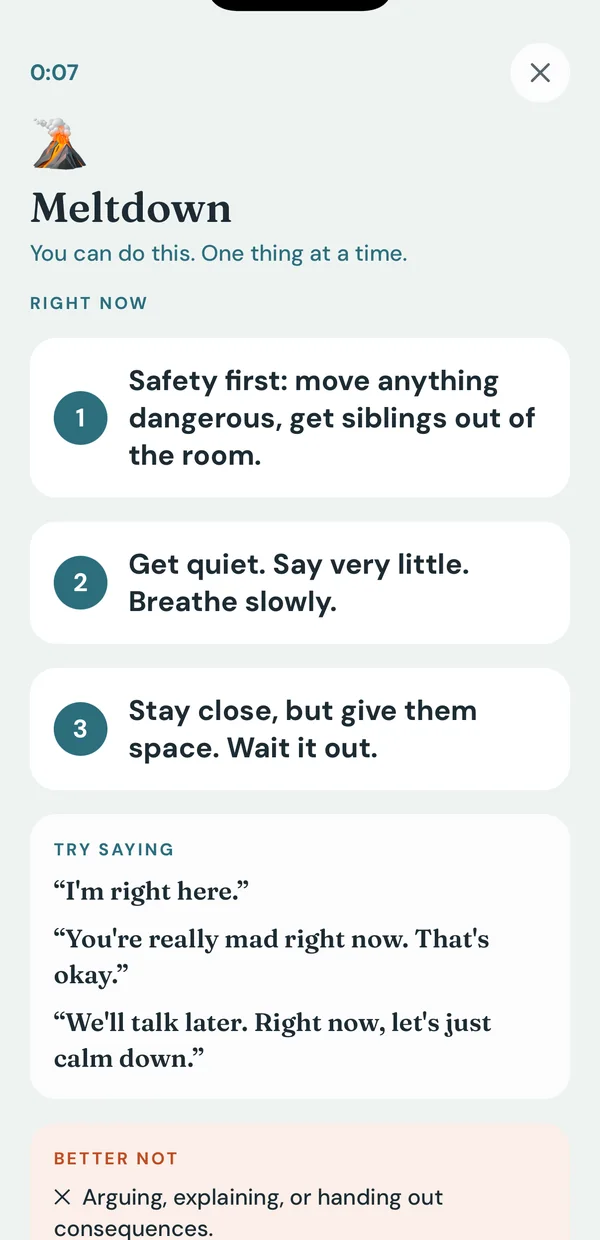
Step 1: Check safety
Is anyone at risk of getting hurt? Move siblings out of the room, put breakable or dangerous objects out of reach, and give your child space. If it's a non-dangerous outburst (yelling, crying, stomping), you don't need to stop it. You need to ride it out.
Step 2: Regulate yourself first
Your calm is contagious, and so is your panic. Before you say anything:
- Breathe out slowly, longer than you breathe in. The Child Mind Institute calls slow breathing a go-to technique because "it's always available to you."
- Lower your voice and your body: sit down, relax your shoulders.
- Remind yourself: "This is a storm. Storms pass."
If you're about to lose it, it's okay to step away for a moment while your child is safe. That's not giving up; it's modeling what you want them to learn.
Step 3: Use very few words
Long explanations are fuel on the fire. Choose one short, calm phrase and repeat it if needed:
- "I'm here."
- "You're safe. I'll wait."
- "You're really angry. I get it."
Instead of: "Why are you acting like this? You're ruining the whole evening! If you don't stop right now, no TV for a week!" Try: Sit nearby, quietly. "I'm right here. When you're ready, we'll figure it out."
Step 4: Don't give in, and don't escalate
Giving your child what they were melting down about teaches the brain that meltdowns work. The Child Mind Institute warns that giving in only teaches that tantrums work, and that arguing or scolding can reinforce the behavior too, because it's still attention. You don't need to lecture or punish in the moment. Just hold the line calmly: "The answer is still no. I'm here when you're calmer."
Step 5: Offer a way down
As the intensity drops, offer a calm-down tool, without forcing it:
- "Want to blow up a balloon with me?" (slow belly breaths)
- "Turtle time?" (curling up in a shell, breathing, coming out when ready)
- A drink of water, a cozy corner, a weighted blanket, a squeeze ball
The Stormproof app's SOS section has a meltdown guide with three steps, phrases to say, and what to avoid, plus calm-down exercises like the balloon, the turtle, and 5-4-3-2-1 grounding. Many parents practice these with their child on good days, so they're familiar when it counts.
When your child gets aggressive
"ADHD child aggressive" is one of the most common searches from exhausted parents, and one of the hardest topics to talk about. Hitting, kicking, biting, or throwing things at people is frightening, especially as kids get bigger.
The Child Mind Institute is clear that ignoring is not appropriate when a child gets physical, because someone can get hurt. What to do instead:
- Protect first. Block, move away, put distance between your child and others. Take siblings to another room.
- Younger children: a calm-down area with nothing rewarding in it, where they can settle without an audience.
- Older children you can't physically move: remove yourself (and others) from their vicinity.
- Stay short and steady: "I won't let you hit me. I'm going to step back until you're safe."
- In extreme cases, when someone is in danger and you can't keep everyone safe, it may be necessary to call 911.
Aggression doesn't mean your child is a "bad kid" or will become a violent adult. But it does mean you need support. The Child Mind Institute advises getting professional help when outbursts are frequent, frightening, or disrupting family life. If your child talks about wanting to die or hurt themselves, call or text 988 (Suicide & Crisis Lifeline).
Afterward: repair, reflect, practice
This is where the real learning happens. The Child Mind Institute recommends saving problem-solving for when no one is upset, and praising efforts to calm down and compromise.
Reconnect first
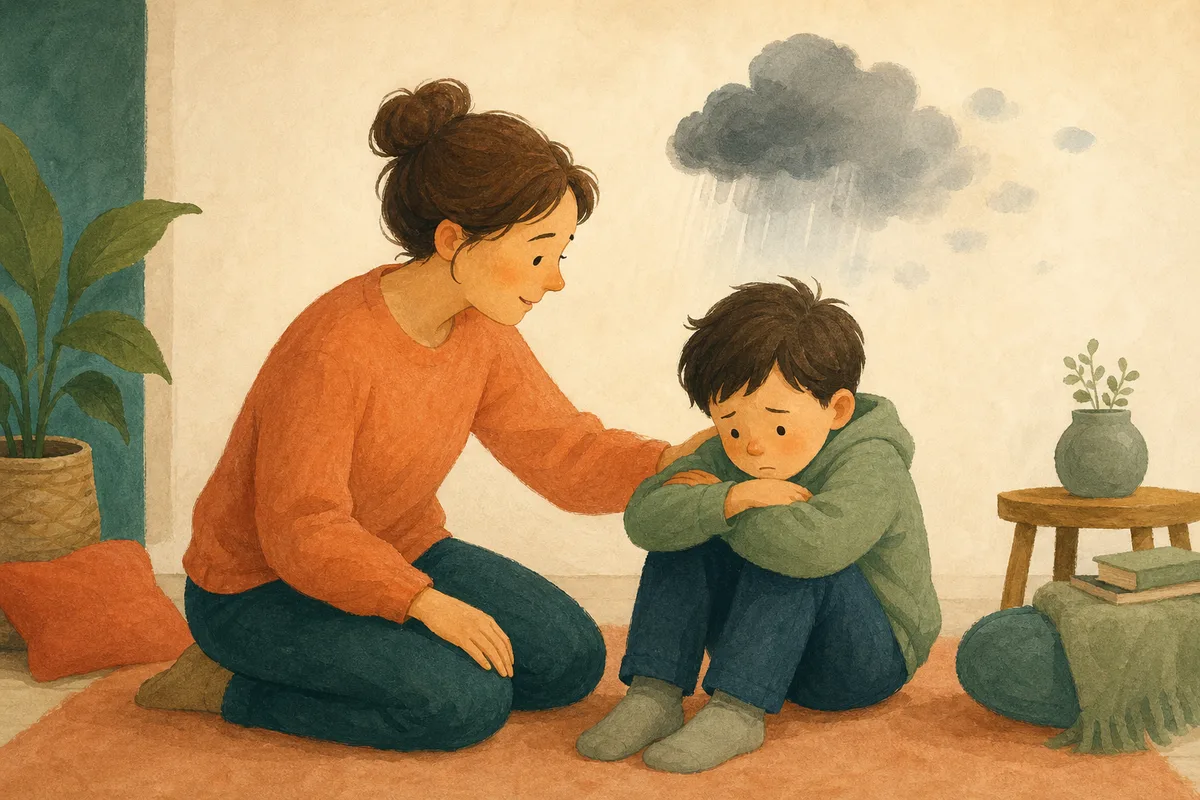
Your child may feel ashamed, scared that you're still angry, or may act as if nothing happened. Start with connection: a hug, sitting together, a snack. "That was hard. I still love you. Always."
Keep the talk short
Wait until everyone is truly calm, maybe an hour later or at bedtime. Then:
- Name it: "You got really angry when the iPad ran out."
- Validate: "That's frustrating. I'd be annoyed too."
- Problem-solve together: "What could help next time? Should we charge it before you start, or set a timer so it's not a surprise?"
- Repair if needed: If something was broken or someone was hurt, help your child make amends: helping clean up, drawing an apology picture, saying sorry when they're ready. Don't force a hollow apology in the heat of the moment.
Praise the recovery
"You calmed down faster than last time. I noticed." Even small progress deserves recognition.
Repair your own mistakes, too
If you yelled, own it: "I yelled, and I'm sorry. I was really frustrated, and I want to handle it better too." This teaches your child that mistakes can be fixed, which is a powerful lesson for a child who makes a lot of impulsive ones.
Prevention: changing the trigger instead of the reaction
The Child Mind Institute recommends looking closely at what happens right before, during, and after outbursts. Typical triggers include homework, bedtime, and "time to stop playing."
Track patterns for two weeks
Write down each meltdown: time, place, what happened right before, how long it lasted, what helped. You'll often find a few "hot spots." The Stormproof pattern radar can do this tracking for you and show, for example, that most hard moments happen between 4 and 6 p.m. or after screen time.
Common triggers and fixes
| Trigger | What often helps |
|---|---|
| Stopping screens or play | Warnings at 10, 5, and 1 minutes; a visual timer; agreeing on a stopping point in advance. See our screen time guide. |
| Hunger and fatigue | A snack right after school, downtime before homework, protecting sleep (see our bedtime guide). |
| Unexpected changes | Preview the day in the morning: "First dentist, then grocery store, then home." |
| Big, vague tasks | Break them into small, concrete steps: not "clean your room," but "put the Legos in the bin." |
| Long waits, boring places | Bring a "waiting kit," keep outings short, plan movement breaks. |
| Too many instructions | One instruction at a time, with eye contact. |
Build routines
Predictable mornings, after-school routines, and bedtimes reduce the number of decisions and surprises, and with them, the number of meltdowns. Our guide on ADHD routines explains how to set them up.
Catch them being calm
The Child Mind Institute emphasizes that structure, clear instructions, and consistent praise for good behavior work better than punishment or yelling. Notice and name the calm moments: "You were disappointed about the park closing, and you handled it so well."
When to get professional help
Consider talking to your pediatrician or a mental health professional if:
- Meltdowns are frequent (several times a week) or getting worse
- Your child is aggressive toward people or animals
- Outbursts last a very long time or seem out of proportion again and again
- Your child seems sad, anxious, or hopeless between meltdowns
- You feel like you can't cope
For serious behavior problems in kids with ADHD, the Child Mind Institute calls parent training "the most effective treatment." The AAP also recommends behavioral parent training as part of ADHD treatment. It isn't a judgment of your parenting. It's specialized coaching for a situation that's genuinely harder than average.
Frequently Asked Questions
At what age should meltdowns stop?
Tantrums are typical around age two. The Child Mind Institute notes that frequent meltdowns in children over about five may point to problems with self-regulation, which is common in kids with ADHD or anxiety. That doesn't mean something is "wrong" with your child, only that they need more help building the skill.
Should I use time-outs for ADHD meltdowns?
The Child Mind Institute says time-outs for nonviolent misbehavior can work well for children younger than about 7 or 8, especially when combined with lots of positive attention. During a true meltdown, though, a calm-down space framed as a place to recover usually works better than a punishment.
Is my child's aggression a sign of something other than ADHD?
It can be, but it often isn't. Many kids with ADHD struggle with anger because of impulsivity. Some children also have co-occurring conditions such as oppositional defiant disorder or anxiety. Only a professional evaluation can sort this out, so mention aggression specifically to your pediatrician.
What if I lose my temper too?
You're human. Step away when you can, repair afterward, and be kind to yourself. If you recognize impulsivity and quick anger in yourself, our guide on parenting with ADHD may help.
Sources
- Effective Ways to Handle Child Tantrums – Child Mind Institute, accessed 2026
- ADHD Behavior Problems: Tantrums, Anger & Defiance – Child Mind Institute, accessed 2026
- How to Manage Anger in Kids – Child Mind Institute, accessed 2026
- Emotional Regulation for Kids: How to Help – Child Mind Institute, accessed 2026
- Treatment of ADHD – Centers for Disease Control and Prevention (CDC), accessed 2026
- Clinical Practice Guideline for the Diagnosis, Evaluation, and Treatment of ADHD in Children and Adolescents – Wolraich et al., Pediatrics, 2019
- 988 Suicide & Crisis Lifeline – Substance Abuse and Mental Health Services Administration (SAMHSA), accessed 2026