 Stormproof
In this article
Key takeaways
- Emotional dysregulation (big, fast, hard-to-control feelings) isn't one of the official ADHD criteria, but research shows it's common in ADHD across the lifespan and a major source of difficulty.
- Typical patterns include quick frustration, irritability, intense reactions to small setbacks, and feeling easily hurt or criticized.
- Emotional regulation is a skill. Kids with ADHD can build it, but they need more coaching, more practice, and more patience than other kids.
- Sometimes moodiness points to something more: anxiety, depression, or oppositional defiant disorder (ODD) often occur together with ADHD. Only a professional can sort that out.
- Persistent sadness, hopelessness, or talk of self-harm always deserves prompt attention. Call or text 988 in a crisis.
Your daughter bursts into tears because her sandwich is cut the wrong way. Your son, usually sweet and funny, comes home from school and snaps at everyone for an hour. A friend's teasing joke ruins your child's entire weekend. One moment there's sunshine, the next there's a storm, and you're never quite sure which word will tip things over.
If this sounds like your house, you're not imagining it, and you're not raising a "drama queen" or a "difficult kid." Emotional dysregulation is one of the most common and least talked-about parts of ADHD in children. This guide explains what's going on, what's typical, how you can help, and when it makes sense to look more closely.
What is emotional dysregulation?
Emotional regulation is the ability to notice a feeling, keep it at a manageable level, and respond in a way that fits the situation. Emotional dysregulation is when that process gets stuck: feelings come too fast, too strong, or last too long.
In a widely cited 2014 review in the American Journal of Psychiatry, Shaw and colleagues concluded that emotion dysregulation is "prevalent in ADHD throughout the lifespan and is a major contributor to impairment." The review also noted that current ADHD treatments often improve emotion dysregulation as well.
Emotional symptoms are not part of the official DSM-5 criteria for ADHD, and experts still debate whether they should be considered a core feature. But for many families, they're the hardest part of daily life. The Child Mind Institute notes that while outbursts aren't ADHD symptoms, more than half of kids with ADHD have them, linked to impulsivity and difficulty managing strong emotions.
What it looks like
Quick to anger, slow to cool down
- Frustration that jumps from zero to a hundred in seconds
- Yelling, slamming doors, or throwing things over small setbacks
- Taking a long time to calm down, even after the problem is solved
Irritability and moodiness
- Grumpy and short-tempered, especially after school or when tired or hungry
- Mood swings that seem to come out of nowhere
- Everything feels "unfair"
Easily hurt
- Feeling crushed by criticism, even gentle correction
- Interpreting neutral comments as rejection ("She looked at me weird, she hates me")
- Dwelling on social hurts for days
Many parents come across the term "rejection sensitive dysphoria" (RSD) online. It's a popular description of intense reactions to perceived rejection, but it's not an official diagnosis, and research on it is limited. The experience it describes is real for many kids, though: being extremely sensitive to criticism or exclusion.
Big positive emotions, too
Dysregulation isn't only negative. Many kids with ADHD also feel excitement, enthusiasm, and joy at full volume: wildly excited about a birthday, bouncing with happiness, then crashing when it's over.
Why ADHD and emotions are so connected
Researchers are still working out the exact mechanisms. Shaw's review suggests that some people with ADHD may have difficulties orienting toward, recognizing, or directing attention to emotional information. In everyday language, several things come together:
- Impulsivity: the gap between feeling and reacting is very short
- Attention: it's hard to shift attention away from something upsetting
- Exhaustion: a child who works hard all day to sit still and focus has little reserve left
- Accumulated frustration: constant correction and failure experiences build up
None of this means your child is choosing to overreact. And none of it is caused by your parenting.
How you can help: coaching emotions step by step
The Child Mind Institute frames emotional regulation as a skill that can be taught: isolate it, practice it, and give calm, non-judgmental feedback. Children with ADHD often need more support than others to build it, but they can.
1. Name the feeling, without judging it
Children can't manage feelings they can't name. Help them build the vocabulary.
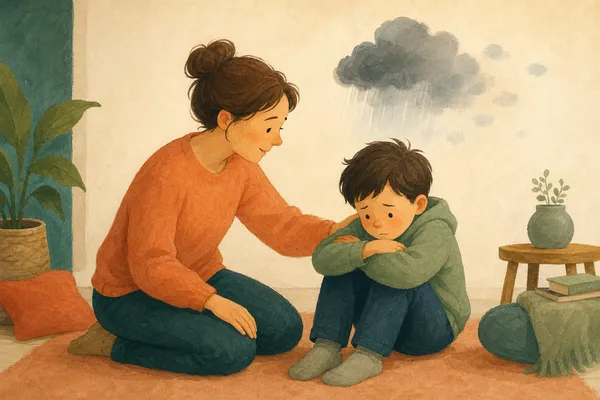
Instead of: "You're overreacting. It's just a sandwich." Try: "You're really frustrated. You wanted it cut in triangles, and it's in squares. That's annoying."
Naming the feeling doesn't mean agreeing with the behavior. You can say: "You're allowed to be mad. You're not allowed to throw the plate."
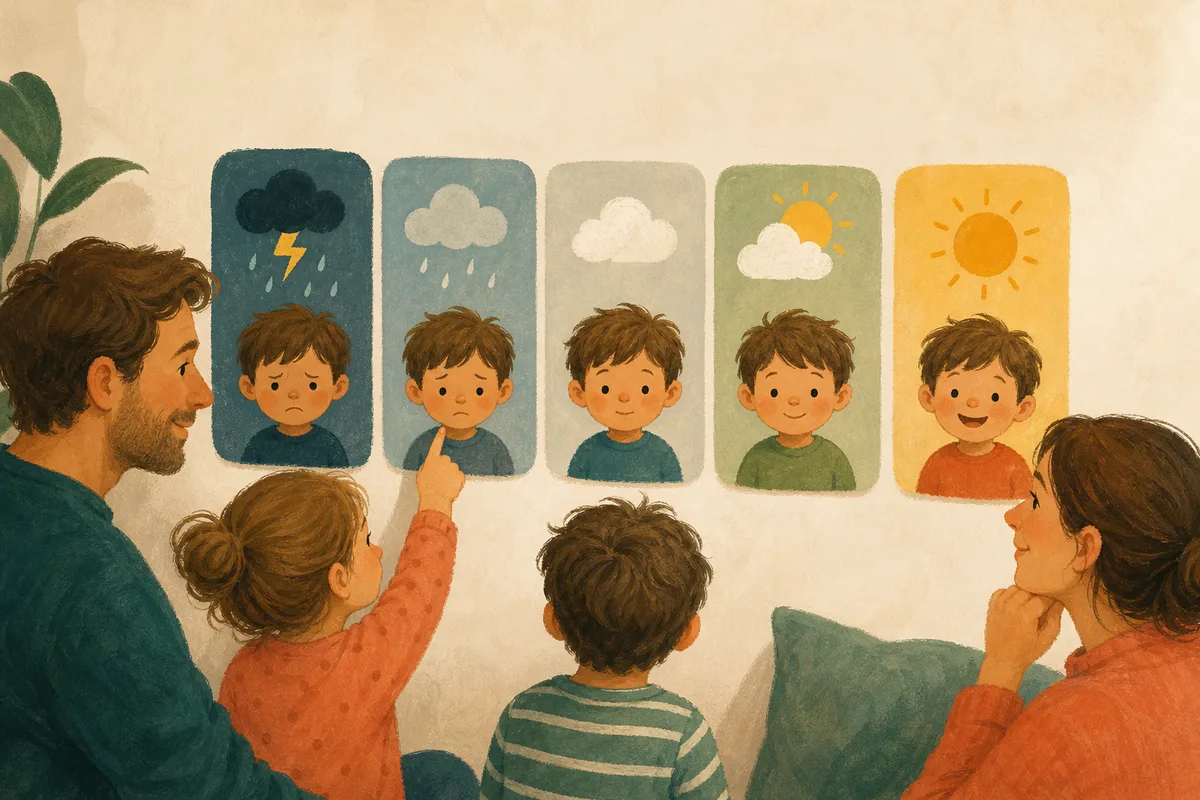
2. Use a feelings scale
A simple scale from 1 to 5 (or green, yellow, red) helps kids notice feelings before they explode.
- 1 / green: calm
- 3 / yellow: getting frustrated, body getting tense
- 5 / red: about to blow
Ask regularly, not only in tough moments: "Where are you on the scale right now?" Over time, kids learn to recognize the yellow zone, which is when strategies actually work.
3. Practice calm-down tools when everyone is calm
Strategies don't work in the middle of a storm if they've never been practiced. Try them on good days:
- Balloon breathing: breathe in slowly, filling the belly like a balloon, then let the air out slowly
- Turtle: pulling into a shell, breathing, and coming out when ready
- 5-4-3-2-1 grounding: name 5 things you see, 4 you hear, 3 you can touch, 2 you smell, 1 you taste
- Movement: jumping, running a lap, pushing against a wall
The Stormproof app has these calm-down exercises built in, in a child-friendly format, so you can practice them together.
4. Coach, don't take over
The Child Mind Institute warns against hovering. If parents solve every frustration, kids don't build their own skills, and may even feel that the parent is the source of the frustration. Instead, offer a little support, then step back: "That puzzle piece won't fit. Want to try turning it? I'll watch."
5. Plan for predictable hot spots
Look for patterns. Is it always after school? Before dinner? On Sunday evenings? If you know the hot spots, you can prepare:
- A snack and quiet time before homework
- Less scheduled on days after big events
- Extra sleep protection (see our bedtime guide)
6. Reflect afterward, briefly
After an outburst, when everyone is calm:
- "What happened in your body before you got so mad?"
- "What could help next time?"
- "You calmed down by yourself this time. How did you do that?"
Keep it short. Long lectures feel like punishment. Our guide on ADHD meltdowns has more on handling the moment itself.
7. Protect self-esteem
Kids who are often "too much" start to believe they're bad. Balance every correction with genuine connection and praise. Make sure your child hears more about what they do well than about what goes wrong.
When to look more closely
Emotional ups and downs are common with ADHD. But according to the CDC, children with ADHD are more likely than other children to also have other conditions. Nearly 78% have at least one co-occurring condition, about 4 in 10 have anxiety, and almost half have a behavior or conduct problem. It's not your job to diagnose these, but it helps to know the signs that are worth mentioning to your pediatrician. The AAP recommends that every child with ADHD be screened for other conditions.
Anxiety
- Frequent worries, fears, or "what ifs"
- Stomachaches or headaches without a clear medical cause
- Avoiding school, social situations, or new things
- Restlessness and trouble sleeping (which can look a lot like ADHD)
Depression
NIMH notes that children and adolescents with depression may be irritable rather than sad. Other signs include:
- Losing interest in things they used to enjoy
- Low energy, changes in sleep or appetite
- Saying things like "I'm worthless," "Nobody likes me," or "I wish I was never born"
- Pulling away from friends and family
The CDC notes that children with ADHD are more likely to develop depression, especially when they struggle at school or with friends.
Oppositional defiant disorder (ODD)
ODD involves a persistent pattern of angry, defiant, or vindictive behavior. The American Academy of Child & Adolescent Psychiatry (AACAP) lists signs such as frequent temper tantrums, excessive arguing with adults, active refusal to follow rules, deliberately annoying others, blaming others, and spitefulness. AACAP notes it becomes a concern when the behavior is so frequent and consistent that it stands out compared with other children of the same age. The Child Mind Institute reports that as many as 40% of kids with ADHD are also diagnosed with ODD.
Disruptive mood dysregulation disorder (DMDD)
NIMH describes DMDD as ongoing irritability and anger with frequent, intense temper outbursts that are severe and show up in more than one setting. If your child seems irritable or angry nearly all the time, not just during outbursts, mention it to your doctor.
What to do
- Write down what you're noticing, including how often and for how long
- Talk to your pediatrician; ask specifically about screening for anxiety, depression, or behavior disorders
- Ask the school if they see similar patterns
The Stormproof history and pattern radar can help you collect this information over a few weeks and share a report with your pediatrician or school.
If your child talks about wanting to die, hurting themselves, or seems to be in danger: call or text 988 (Suicide & Crisis Lifeline, free, 24/7) or 911 in an emergency.
Taking care of yourself
Living with a child whose emotions run this hot is exhausting. You're not failing if you feel drained, frustrated, or even resentful sometimes. Our guide on support for parents of kids with ADHD has ideas for finding help and recharging.
Frequently Asked Questions
Is emotional dysregulation a symptom of ADHD?
It's not part of the official diagnostic criteria, but research shows it's very common in people with ADHD and a major source of everyday difficulty. Experts are still debating whether it should be considered a core feature of ADHD or a closely related problem. Either way, it deserves attention in treatment.
Can ADHD treatment help with mood swings?
Research suggests that current ADHD treatments often also improve emotional dysregulation. Behavioral parent training and skill-building also help many families. If moodiness persists despite treatment, talk with your doctor about whether something else, such as anxiety or depression, may be involved.
How do I know if it's ADHD or something like bipolar disorder?
Some symptoms, like irritability and mood swings, overlap across several conditions, which is why a careful professional evaluation matters. Episodic, distinct periods of very elevated mood and reduced need for sleep are different from the everyday ups and downs common in ADHD. Talk to your pediatrician or a child psychiatrist about your specific concerns.
My child says "I hate myself" during meltdowns. Should I worry?
Take it seriously, even if it seems like something said in the heat of the moment. Stay calm, listen, and let your child know you're there. Talk to your pediatrician or a mental health professional soon, and if you're worried about immediate safety, call or text 988 or call 911.
Sources
- Emotion dysregulation in attention deficit hyperactivity disorder – Shaw, Stringaris, Nigg & Leibenluft, American Journal of Psychiatry, 2014
- Emotional Regulation for Kids: How to Help – Child Mind Institute, accessed 2026
- ADHD Behavior Problems: Tantrums, Anger & Defiance – Child Mind Institute, accessed 2026
- Data and Statistics on ADHD – Centers for Disease Control and Prevention (CDC), accessed 2026
- Other Concerns and Conditions with ADHD – CDC, accessed 2026
- Depression – National Institute of Mental Health (NIMH), accessed 2026
- Disruptive Mood Dysregulation Disorder – NIMH, accessed 2026
- Children With Oppositional Defiant Disorder (Facts for Families No. 72) – American Academy of Child & Adolescent Psychiatry (AACAP), accessed 2026
- Child and Adolescent Mental Health – NIMH, accessed 2026