 Stormproof

In this article
Key takeaways
- Behavioral parent training is an evidence-based ADHD treatment. The CDC calls it the recommended first choice for children under 6, and the AAP recommends parent training as part of treatment for children up to age 12.
- PCIT (Parent-Child Interaction Therapy) is a coached program for children ages 2 to 7. A therapist guides you in real time through an earpiece.
- CHADD offers parent education (Parent to Parent), local chapters and support groups, and a National Resource Center you can call.
- Federally funded Parent Training and Information Centers help families navigate school services and special education.
- In a mental health crisis, call or text 988, any time, day or night.
Maybe you've read every article, tried every chart, and still end most evenings exhausted. Maybe you feel like the only parent at school pickup whose child had another rough day. Or maybe you just want someone to talk to who gets it.
Raising a child with ADHD is a lot of work, and getting support isn't a sign of failure. It's part of good treatment. This guide gives you an overview of where to find ADHD parent support in the U.S.: from structured parent training to support groups, school resources, respite care and crisis help. We've only included offers we could verify, and we link to each one.
Behavioral parent training: the core treatment
What it is
Behavioral parent training (BPT), also called parent training in behavior management, teaches you specific skills to help your child's behavior and your relationship. According to CHADD, it's delivered by a mental health professional, in person, in groups, or by video, and typically covers:
- Household rules, organization and routines
- Giving clear instructions
- Praising good behavior and ignoring mild misbehavior
- Planning ahead for outings
- Using charts and point systems with rewards and consequences
The CDC notes that parents typically attend 8 to 16 sessions with a therapist.
What the evidence says
The CDC describes parent training as an effective treatment for children with ADHD and states that behavior therapy is most effective in young children when it's delivered by parents. According to the CDC's summary of AAP recommendations:
- Under age 6: behavior therapy, with parent training as the main approach, is recommended first, before trying medication.
- Age 6 and older: the AAP recommends medication together with behavior therapy. Parent training is recommended for children up to age 12.
CHADD is honest about the effort: using BPT skills takes a lot of hard work. But parents who use them regularly tend to see better behavior and better relationships at home.
How to find a program
- Ask your pediatrician for a referral to a therapist who offers ADHD parent training or "parent management training."
- Ask therapists directly: "Do you offer behavioral parent training for ADHD? How many sessions? Is it individual or group? Is telehealth available?"
- Check with your insurance which providers are in-network (see below).
If you have ADHD yourself, mention it. Standard programs don't always fit parents with ADHD. Read more in our guide for a parent with ADHD.
Parent-Child Interaction Therapy (PCIT)
PCIT is a well-known form of behavioral parent training for young children, typically ages 2 to 7, with frequent tantrums, aggression, defiance or trouble regulating emotions. It was developed by psychologist Sheila Eyberg.
What makes PCIT different is live coaching: a therapist watches you play with your child, often through a one-way mirror, and gives you real-time feedback through a small earpiece. PCIT has two phases:
- Child-Directed Interaction: you learn to follow your child's lead in play, building warmth and cooperation.
- Parent-Directed Interaction: you learn to give clear instructions, set consistent limits and follow through with predictable consequences.
PCIT International describes PCIT as an evidence-based treatment and offers a "Find a Provider" directory of certified therapists, including providers offering telehealth.
CHADD: education, support groups and answers
CHADD (Children and Adults with Attention-Deficit/Hyperactivity Disorder) is a national nonprofit focused on ADHD, with resources for families, adults and educators.
Parent to Parent
CHADD's Parent to Parent program is an online training program that educates parents about ADHD. Topics include ADHD symptoms and causes, assessment, treatment options, creating an ADHD-friendly home and supporting your child at school. Courses are pre-recorded and self-paced. CHADD members get a discount. Note: Parent to Parent is education, not therapy. It complements behavioral parent training with a professional but doesn't replace it.
Local chapters and support groups
CHADD has a nationwide network of chapters and support groups offering in-person and virtual peer support, education and community. Use the "Find a Local CHADD" locator on its website to search by state. Talking to other parents who live the same daily reality is, for many, the most relieving part.
National Resource Center on ADHD
CHADD's National Resource Center lets you contact an ADHD specialist by phone at 1-866-200-8098, Monday to Friday, 1 to 5 p.m. Eastern. Spanish is available.
School and community resources
Your child's school
The school is one of your most important partners. The school counselor, psychologist or special education coordinator can help with evaluations, a 504 plan or an IEP. Our guide to the 504 plan vs. IEP for ADHD explains how to request one.
Parent Training and Information Centers
There are nearly 100 Parent Training and Information Centers (PTIs) and Community Parent Resource Centers across the U.S. and its territories. They're funded by the U.S. Department of Education's Office of Special Education Programs and help families of children with disabilities take an active part in their education. They're a great place to call before an IEP or 504 meeting. Find your center through the Center for Parent Information and Resources at parentcenterhub.org.
Pediatrician
Your pediatrician coordinates much of your child's ADHD care, from diagnosis and medication to referrals. Bring notes on what you see at home. The Stormproof app's pattern radar and report can help you summarize observations for the pediatrician or the school.
Respite: a break for you
Respite care is planned or emergency care for a child with special needs that gives family caregivers temporary relief. The ARCH National Respite Network offers a search tool to find respite providers and programs in your area. Availability and eligibility vary by state and program, so call and ask.
Respite can also be informal: a grandparent who takes your child one afternoon a week, a babysitter who knows ADHD, a trade with another family from your support group.
Insurance basics
Insurance rules are complicated and vary by plan, but a few basics help:
- Marketplace plans (HealthCare.gov and state exchanges) must cover mental health and substance use services as essential health benefits, including behavioral health treatment such as psychotherapy and counseling.
- Parity: Under HealthCare.gov rules, limits on mental health benefits can't be more restrictive than limits on medical and surgical benefits.
- Pre-existing conditions: Marketplace plans can't deny coverage or charge more because of a pre-existing condition.
Practical steps:
- Call the member services number on your card and ask: "Is behavioral parent training for ADHD covered? Which in-network providers offer it? Is prior authorization needed? Is telehealth covered?"
- Ask the provider for the billing codes they use, so you can check coverage in advance.
- Keep records of calls: date, name, what you were told.
Employer plans, Medicaid and CHIP have their own rules, so check your plan documents or ask your state's Medicaid office. If cost is a barrier, ask providers about sliding-scale fees, or ask a local CHADD chapter about low-cost options in your area.
When it's a crisis
Sometimes things get bigger than a hard day: your child talks about wanting to die, you're afraid someone will get hurt, or you feel like you can't go on.
- Call or text 988, or chat at 988lifeline.org, to reach the 988 Suicide & Crisis Lifeline. It's free, confidential and available 24/7. It's for anyone, including parents, kids, and people worried about a loved one, and not only for suicidal thoughts: it also helps with emotional distress and mental health struggles.
- In immediate danger, call 911.
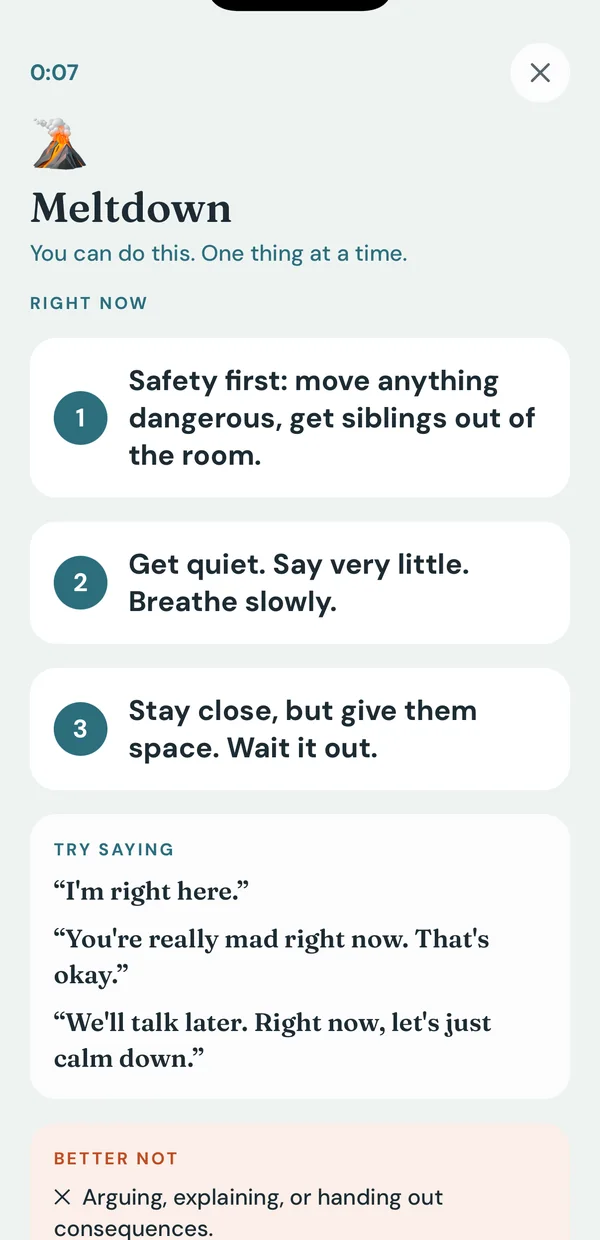
And for those everyday moments when you're about to lose your temper, the Stormproof app has an SOS for "I'm about to lose it myself," with three quick steps to get through the next minute. Our article on ADHD and impatience has more ideas.
Frequently Asked Questions
What is ADHD parent training?
Behavioral parent training teaches parents specific skills, like clear instructions, specific praise, routines and point systems, to improve a child's behavior. It's delivered by a mental health professional, typically over 8 to 16 sessions according to the CDC, and it's a recommended part of treatment for children with ADHD.
Is parent training only for young children?
It's the recommended first treatment for children under 6, and the AAP recommends parent training for children with ADHD up to age 12, alongside other treatment. For teens, other behavior therapies and training are recommended, according to the CDC.
Are there free ADHD support groups for parents?
CHADD has local chapters and support groups across the country, many offering online meetings. Check the "Find a Local CHADD" locator on CHADD's website for options and costs near you.
Does insurance cover ADHD parent training?
It depends on your plan. Marketplace plans must cover behavioral health treatment, and mental health benefits must be on par with medical benefits. Call your insurer to ask about coverage, in-network providers and prior authorization.
Sources
- Treating ADHD – Centers for Disease Control and Prevention
- Parent Training in Behavior Management for ADHD – Centers for Disease Control and Prevention
- Parent Training and Education – CHADD
- Parent & Family Education (Parent to Parent) – CHADD
- Find a Local CHADD – CHADD
- About PCIT – PCIT International
- Find Your Parent Center – Center for Parent Information and Resources
- ARCH National Respite Network – ARCH National Respite Network and Resource Center
- Mental health & substance abuse coverage – HealthCare.gov
- 988 Suicide & Crisis Lifeline – 988 Lifeline