 Stormproof

In this article
Key takeaways
- ADHD runs strongly in families. A major research review found an average heritability of 74% across twin studies. If your child has ADHD, it's worth looking at your own story.
- Two people with ADHD under one roof can escalate fast: two short fuses, two people who hate waiting, both easily overwhelmed.
- Parents with ADHD tend to benefit less from standard parent training programs. That's not a personal failure. It's a reason to get support that fits your brain too.
- Adults can be diagnosed and treated. The first step is talking with your own healthcare provider.
- Your ADHD also brings strengths: energy, creativity, the ability to hyperfocus, and deep understanding for your child.
You're reading the school report about your child: "has difficulty waiting their turn," "easily distracted," "often doesn't finish tasks." And somewhere in the back of your mind, a quiet voice says: That was me. That's still me.
Many parents first start wondering about their own ADHD when their child is diagnosed. Maybe you've always been the one who's late, who starts five projects and finishes one, who gets snappy when things take too long, but who can also disappear into a task for hours and come out with something remarkable.
If you're a parent with ADHD raising a child with ADHD, this guide is for you. Not to add another to-do list, but to help you understand what's happening between the two of you, and what makes it easier.
ADHD runs in families
This isn't a coincidence. In a widely cited review in Molecular Psychiatry, researchers Stephen Faraone and Henrik Larsson report that the mean heritability across 37 twin studies of ADHD is 74%. The same review describes a large study that found a ninefold increased risk of ADHD in siblings of children with ADHD.
What heritability means, and doesn't mean: it describes how much of the differences between people in a population can be explained by genetic differences. It does not mean your child has a 74% chance of inheriting ADHD from you, and it doesn't mean anyone is to blame. Genes are passed on without anyone choosing them.
What it does mean in practice: if your child has ADHD, there's a real possibility that you, your partner or other relatives have it too, diagnosed or not.
When two ADHD brains collide
Two short fuses
Many adults with ADHD know this feeling well: an intense impatience, where things that don't go fast enough feel almost physically unbearable. Waiting in line, slow internet, a child who needs four minutes to put on one shoe. The irritation comes fast, and the words come out sharper than intended.
Now add a child who also reacts quickly and intensely. The child gets frustrated, you get frustrated with the frustration, the child senses your tension and escalates, you raise your voice. Within seconds, two people are in full stress mode, and neither can step on the brakes. Our article on ADHD and emotional dysregulation explains why emotions spike so quickly with ADHD.
Hyperfocus: superpower and trap
Hyperfocus is the other side of the coin. When something really interests you, you can work on it for hours, with an intensity others can't match. That's a genuine strength, at work, in hobbies, and also as a parent: you can dive into your child's world of dinosaurs or Minecraft with full enthusiasm.
The trap: hyperfocus doesn't switch off on schedule. If you're absorbed in an email when your child needs to leave for practice, being interrupted can feel like being torn out of the water, and your reaction may be harsher than the situation deserves. Our guide to ADHD and hyperfocus covers this in more detail.
Structure is hard for both of you
Routines, reminders, the forgotten permission slip: your child needs structure from outside, and you may be the person in the family who finds it hardest to provide. That isn't a character flaw. It's the same executive function challenge, one generation up.
Why standard parenting advice may not fit
Behavioral parent training is one of the best-supported treatments for childhood ADHD. But a 2025 randomized trial in BMC Psychiatry notes that parents with ADHD tend to benefit less from conventional parent training programs than parents without ADHD. Being consistent, remembering to give points, keeping calm in conflict: these all draw on exactly the skills ADHD makes harder.
The same trial tested a parent training program tailored to parents with ADHD and found it improved parents' sense of confidence in their parenting, with reductions in parent-rated child behavior problems as secondary results. Research in this area is still developing. The practical takeaway: if a program didn't work for you, the problem may be the fit, not you. Ask therapists whether they have experience working with parents who have ADHD themselves.
Getting diagnosed and treated as an adult
The CDC notes that some adults have ADHD but have never been diagnosed, and that symptoms can look different in adults. Hyperactivity may fade or show up as intense inner restlessness, and symptoms can become more noticeable as responsibilities grow.
How to start
- Talk to your own healthcare provider. According to the CDC, that's the first step. They may diagnose ADHD or refer you to a mental health professional.
- Expect questions about your childhood. Clinicians check whether symptoms were present before age 12, and they may rule out conditions such as anxiety or depression that can look similar.
- Bring examples. Old report cards, notes from a partner, specific situations at work and at home.
Treatment options
The CDC says ADHD in adults can often be managed with the right treatment, which can include medication, most commonly stimulants, as well as therapy or behavioral approaches, with close monitoring and adjustments as needed. NIMH lists cognitive behavioral therapy among the psychosocial options. What fits you is a decision for you and your clinician.
Many parents say that understanding their own ADHD changed how they see their child: less "Why are you doing this to me?" and more "I know exactly how that feels."
Strategies for calmer days
Know your danger zones
Write down when you most often lose your temper. For many parents with ADHD, it's moments of waiting, transitions under time pressure (mornings!), being interrupted during hyperfocus, and noise plus chaos at the end of the day. Once you know your danger zones, you can plan for them.
Take the time pressure out
Impatience explodes under time pressure. Start mornings 15 minutes earlier, lay out everything the night before, and build buffers into the schedule. Our guide to ADHD routines for kids helps you set this up for both of you.
Let tools do the reminding
You don't have to be the family's memory. Visual timers, checklists on the wall, phone alarms and shared calendars hold the structure so your brain doesn't have to.
Protect your hyperfocus, and announce it
Plan focused work for times when your child is at school or asleep. When you need to focus while your child is around, say so: "I'm working for 20 minutes. When the timer rings, I'm all yours." And set an alarm for yourself, too.
Have a plan for when you're about to lose it
When you feel the heat rising:
- Stop talking. Fewer words means less escalation.
- Create distance. "I need a minute. I'll be right back." Then step into the next room.
- Breathe out slowly, longer than you breathe in.
- Come back and repair. "I was too loud before. I'm sorry. Let's try again."
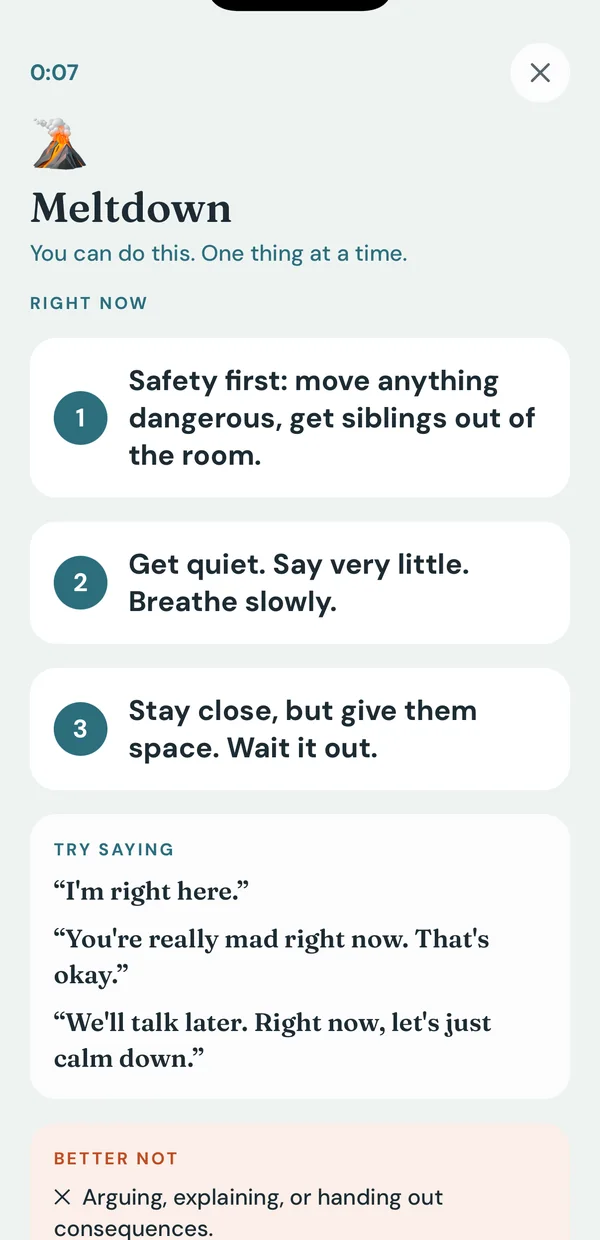
Repair is a powerful thing to model. Your child learns that big feelings happen and can be fixed. The Stormproof app has an SOS for exactly this moment, "I'm about to lose it myself," with three quick steps.
Split roles with your partner
If you have a partner, divide tasks according to strengths. Maybe you do the energetic part, like sports and adventures, and your partner handles the paperwork and school forms. Or vice versa. Not every parent has to be good at everything.
Enjoy what you share
You understand your child from the inside. You know how it feels to be told to "just concentrate." You can laugh about the same chaos, share the same enthusiasm, and show your child that a brain like theirs can build a good life.
Take care of yourself
You can't pour from an empty cup, and ADHD makes it easy to run on fumes. Prioritize sleep, movement and some time that's just yours. Look for people who get it: CHADD runs local chapters and support groups, many of them online. Our guide to ADHD parent support lists more resources.
If you're feeling overwhelmed, hopeless or like you might hurt yourself or someone else, call or text 988 to reach the 988 Suicide & Crisis Lifeline, available 24/7. In an emergency, call 911.
Frequently Asked Questions
Is ADHD inherited from parents?
ADHD has a strong genetic component. A major review found an average heritability of 74% across twin studies, and siblings of children with ADHD have a markedly higher risk. That doesn't mean a child will definitely inherit it, and it's no one's fault.
Can a parent with ADHD be a good parent?
Absolutely. Parents with ADHD often bring energy, creativity and deep empathy for a child who struggles the same way. Some things, like consistency and patience under time pressure, may need extra tools and support, and getting your own ADHD treated can help.
How do I get tested for ADHD as an adult?
Start with your own healthcare provider, who may diagnose ADHD or refer you to a mental health professional. Expect questions about your current life and your childhood, since symptoms need to have been present before age 12.
What if my child and I keep setting each other off?
Identify your shared danger zones, take time pressure out of the day, and have a plan for stepping away before things escalate. Repairing afterward ("I was too loud, I'm sorry") teaches your child as much as staying calm does.
Sources
- Genetics of attention deficit hyperactivity disorder – Faraone & Larsson, Molecular Psychiatry, 2019
- Parent training tailored for parents with ADHD: a randomized controlled trial – Lindström et al., BMC Psychiatry, 2025
- ADHD Across the Lifetime – Centers for Disease Control and Prevention
- Attention-Deficit/Hyperactivity Disorder – National Institute of Mental Health
- Find a Local CHADD – CHADD
- 988 Suicide & Crisis Lifeline – 988 Lifeline