 Stormproof

In this article
Key takeaways
- Games and videos give fast, constant rewards. That's exactly why they hold the attention of kids with ADHD so well, and why switching away is so hard.
- Set expectations before the screen goes on. The Child Mind Institute recommends a visual timer and warnings when 10 or 5 minutes are left.
- Aim for natural stopping points (end of a level, end of an episode) rather than cutting off mid-action.
- The AAP doesn't give one magic number of hours for school-age kids. It recommends consistent limits and a Family Media Plan that protects sleep, homework, activity and family time.
- Screens off at least an hour before bed and out of the bedroom, per the AAP.
"Five more minutes!" "You said that ten minutes ago." "But I'm in the middle of something!" Then the controller flies, the door slams, and the whole evening tips over.
If ending ADHD screen time feels like defusing a bomb every single day, you're not alone, and it's not a sign that your child is spoiled or that you've been too lenient. There are concrete reasons why screens are so hard to leave for kids with ADHD. Once you understand them, you can build a plan that makes stopping much less of a fight.
Why kids with ADHD have such a hard time stopping
Games are built for the ADHD brain
The Child Mind Institute describes video games as "visually appealing and fast-paced, with instant rewards and consequences." For a child who struggles to stay focused on slow, less exciting tasks, that's incredibly engaging. There are no boring gaps. Something always happens, and the next reward is seconds away.
That's also why many parents say, "But he can concentrate, just look at him play!" Focusing on a game is different from focusing on a worksheet. A game constantly supplies the motivation a worksheet doesn't. Some kids with ADHD can also lock in on one game for hours. Read more in our article on ADHD and hyperfocus.
Switching tasks is a core difficulty
ADHD affects the ability to stop one activity and start another, especially when the next one is less fun. Going from a game to brushing teeth means stopping something rewarding, switching gears, and starting something boring, all at once. That's three hard steps, not one.
Big feelings in the transition
Many kids with ADHD feel emotions intensely and quickly. The disappointment of stopping can hit hard and fast. What looks like defiance is often a wave of frustration your child can't yet manage. Our guide to ADHD and emotional dysregulation goes deeper.
What the AAP recommends
The American Academy of Pediatrics doesn't set a single number of hours for school-age kids. Instead, it focuses on balance and on what screens might crowd out. Its "5 Cs" guidance for school-age children (Child, Content, Calm, Crowding Out, Communication) includes points like:
- Keep limits so that kids get schoolwork and other activities done.
- Put devices away at bedtime so kids can settle their brains and bodies for sleep.
- Avoid letting screens become the go-to whenever your child is bored or frustrated with homework.
- Teach other ways to calm down, like deep breathing or quiet music.
- Model it yourself: parents can put phones down at bedtime, at dinner and on car rides.
The AAP also recommends turning screens off at least 60 minutes before bedtime and keeping them out of children's bedrooms.
Step by step: making the switch-off easier
1. Agree on the deal before the screen goes on
The worst time to negotiate is when the game is already running. Child Mind Institute psychologists recommend setting expectations in advance. Before you hand over the tablet, agree on three things:
- How long? ("Thirty minutes" or "two episodes.")
- What happens next? ("Then we have dinner.")
- How will you warn them? Let your child choose: "Do you want a reminder at 10 minutes, 5 minutes, or both?" The Child Mind Institute suggests offering exactly this kind of choice.
Have your child repeat the deal back. It sounds formal, but it gives you something to point back to later.
2. Make time visible
"Ten more minutes" means almost nothing to many kids with ADHD. A visual timer showing time disappearing makes it concrete. The Child Mind Institute calls a visual timer "really helpful" for this transition.
3. Give warnings at 10, 5 and 1 minute
Warnings give the brain time to prepare for the switch. Keep them short and friendly, and go to your child rather than shouting across the house:
- "Ten minutes left. Start looking for a good place to stop."
- "Five minutes. Finish this level."
- "One minute. Save your game."
The Stormproof app has a screen-time wind-down tool that runs these 10-, 5- and 1-minute warnings for you.
4. Stop at a natural stopping point
Cutting off a game mid-battle feels unfair, and progress may be lost. Some stopping points are easier than others:
- Easier: end of an episode, end of a level, after saving
- Harder: open-ended games without levels, autoplay video, online matches with friends
For harder formats, agree on a number of matches instead of minutes, turn off autoplay, and plan screen time so it doesn't run straight into a fixed deadline like leaving for practice.
5. Have a landing spot
The moment after the screen goes off is the danger zone. Make the next activity concrete and, if possible, a little appealing: a snack, a short walk with the dog, helping you cook. Avoid going straight from the game to the hardest task of the day.
6. Praise the handover
When your child turns off the screen on time, notice it immediately.
- Instead of: "Finally."
- Try: "You stopped right when the timer ended, even though you were in the middle of a level. That was hard, and you did it."
7. When it blows up anyway
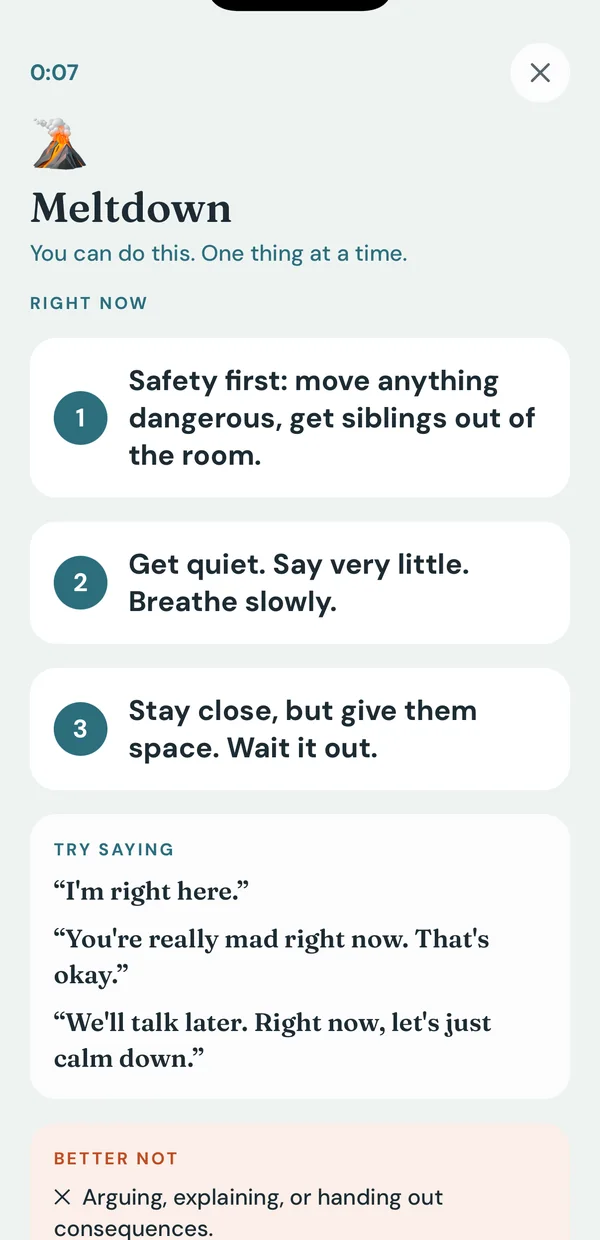
Stay calm, keep your words few, and don't renegotiate in the moment. "I can see you're really mad. The screen is done for today." Talk about what went wrong later, when everyone is calm. If meltdowns happen often, our ADHD meltdowns guide can help.
Create a family media plan
The AAP offers a free online Family Media Plan tool on HealthyChildren.org. It helps families think about media and set rules that fit their values, and the AAP notes it can be especially helpful for school-age kids, who are receptive to setting up and following rules. It's meant for the whole family, parents included.
Good topics for your plan:
- Screen-free times: meals, the hour before bed, car rides
- Screen-free places: bedrooms, the dinner table
- When screens are allowed: for example, after homework and chores
- How screen time ends: warnings, timer, stopping points
- What happens if the deal isn't kept: a small, predictable consequence, like a shorter session tomorrow, decided in advance, not invented in anger
- Rules for parents, too
Write it down, let your child help with the wording, and hang it somewhere visible. The Stormproof app includes a media agreement you can fill out together.
Should screen time be a reward?
Opinions differ. CHADD's Attention magazine suggests tying existing privileges, such as screen time, to positive behavior instead of giving them automatically. On the other hand, making screens the main prize can make them seem even more valuable. A middle path many families use: a basic daily amount that's part of the routine, and other rewards (time with you, a special activity) for extra effort. If you use a point system, our reward chart guide explains how to keep it fair and simple.
Frequently Asked Questions
How much screen time is OK for a child with ADHD?
The AAP doesn't set a specific number of hours for school-age children. It recommends consistent limits that protect sleep, homework, physical activity and family time. Because stopping can be harder for kids with ADHD, clear rules and predictable endings often matter more than the exact number.
Do video games cause ADHD?
No. A Child Mind Institute expert puts it clearly: there is no evidence that TV or video games cause ADHD. Games can, however, be very hard for kids with ADHD to stop, and screen use can crowd out sleep and activity, which can make symptoms harder to manage.
Why does my child melt down when the tablet is turned off?
Stopping a highly rewarding activity, switching tasks and managing disappointment are all harder with ADHD, and they happen at the same moment. Advance agreements, visible timers, warnings and natural stopping points reduce the shock of the switch.
Should screens be completely off before bed?
The AAP recommends turning screens off at least an hour before bedtime and keeping them out of children's bedrooms. For many families, a charging station outside the bedroom is the simplest way to make that stick.
Sources
- The Impact of Video Games on ADHD (Ask an Expert) – Child Mind Institute
- Do Video Games Cause ADHD? – Child Mind Institute, updated 2026
- Kids & Screen Time: 5 C's Questions for School-Age Children – American Academy of Pediatrics / HealthyChildren.org, 2024
- The 5 Cs of Media Use – American Academy of Pediatrics, Center of Excellence on Social Media and Youth Mental Health
- Family Media Plan – American Academy of Pediatrics / HealthyChildren.org
- Healthy Sleep Habits: How Many Hours Does Your Child Need? – American Academy of Pediatrics / HealthyChildren.org
- Cracking the Code on Motivation for Children with ADHD – CHADD, Attention magazine, 2025