 Stormproof
In this article
- Why rewards have to work differently with ADHD
- The three ground rules: immediate, small, concrete
- Setting up a token economy step by step
- Rewards that work (and don't break the bank)
- Praise: the reward you always have with you
- The most common mistakes
- Example: a morning reward chart for a 9-year-old
- Frequently Asked Questions
Key takeaways
- Kids with ADHD have trouble linking actions to consequences when there's a delay. Rewards should come as soon as possible after the behavior, CHADD advises.
- A good chart is small (one to three goals), concrete (behavior you can see) and winnable (your child succeeds in the first days).
- Rewards don't have to cost money. Everyday privileges, time with you and specific praise often work best.
- Punishment alone is not very effective for changing behavior. Small losses can work briefly, but only alongside plenty of positive reinforcement.
- Charts and point systems are a core part of behavioral parent training, which the CDC describes as an effective treatment for children with ADHD.
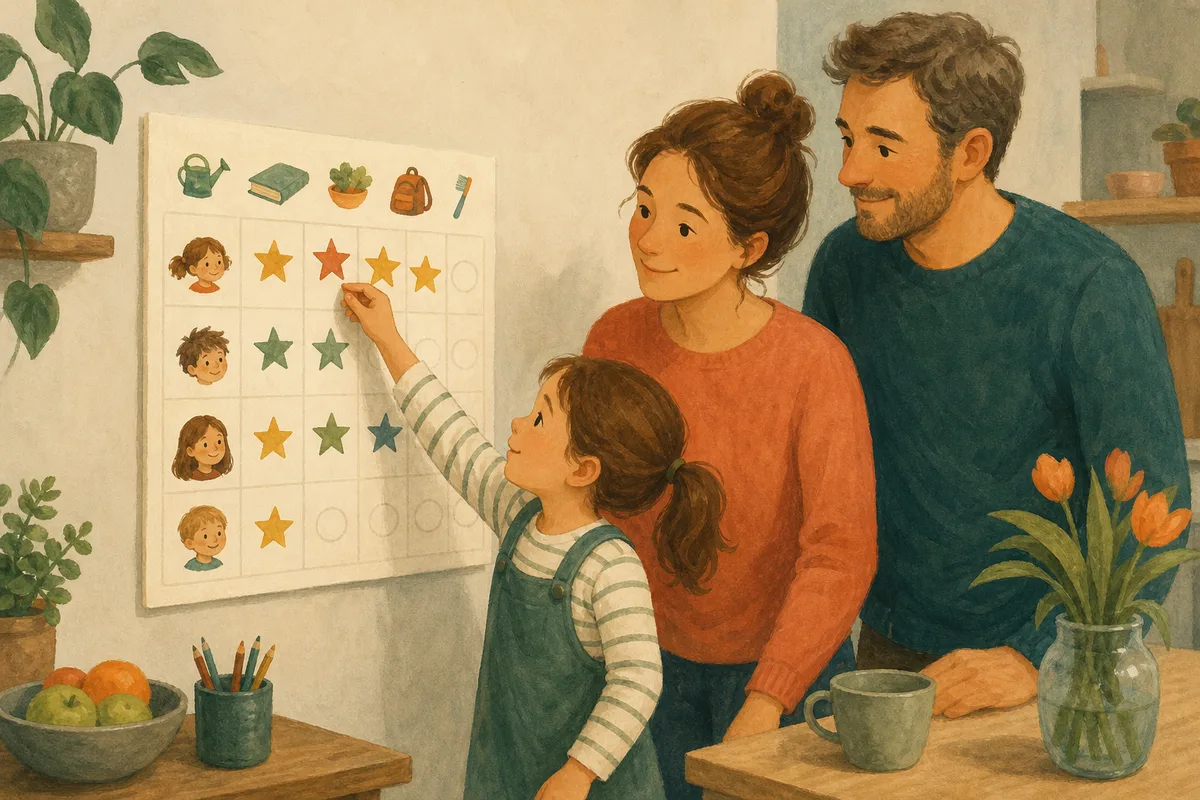
You've probably tried it already: a colorful chart on the fridge, a sticker for every day without fighting, a trip to the trampoline park at the end of the week. The first three days go great. Then you forget the stickers, your child loses interest, and by Friday nobody's quite sure who earned what. The chart disappears under school flyers.
That doesn't mean a reward chart for ADHD can't work. It usually means the chart wasn't built for an ADHD brain. Reward systems for kids with ADHD need to be faster, smaller and more visible than for other kids. This guide shows you how.
Why rewards have to work differently with ADHD
CHADD, the national ADHD organization, explains it simply: children with ADHD can struggle to connect actions with consequences when there's a delay. "Be good all week and we'll go to the movies on Sunday" feels infinitely far away on a Tuesday afternoon. "Finish this worksheet before the timer goes off and you get a point, and we'll stick it on right now" is something your child can feel.
There's a second reason. Many kids with ADHD hear all day long what they're doing wrong. A well-built reward system flips the focus to what's going right. That's not soft parenting. It's one of the core tools of evidence-based treatment. The CDC describes behavioral parent training, in which parents learn to use positive reinforcement, structure and consistent discipline, as an effective treatment for children with ADHD. Using a chart to track goals and reward progress is part of it.
The three ground rules: immediate, small, concrete
Immediate
The point, sticker or token comes right after the behavior: not at dinner, not on the weekend. CHADD advises giving rewards "quickly and often" when a child is learning a new behavior or skill. Bigger "cash-in" rewards can come later, but the token itself shows up on the spot.
Small
Start with one to three goals, no more. A chart with ten goals is a to-do list, not motivation. Pick the behavior that causes the most daily stress, and leave the rest for later.
Concrete
"Be nice" or "listen better" can't be measured, and every evening turns into a debate. Good goals describe what you can see:
- Vague: "Behave in the morning."
- Concrete: "Dressed and shoes on by 7:40."
- Vague: "Do homework without drama."
- Concrete: "Starts homework within 5 minutes of the timer."
- Vague: "Be nicer to your sister."
- Concrete: "Uses words, not hands, when you're mad at your sister."
Phrase goals as what your child should do, not what they shouldn't.
Setting up a token economy step by step
A token economy simply means your child earns points or tokens for specific behaviors and trades them for rewards. Here's how to set one up:
- Choose one to three goals with your child, phrased concretely.
- Pick your tokens. Stickers, checkmarks, marbles in a jar, poker chips. CHADD suggests that different colored tokens for different behaviors can help kids link each reward to the right behavior.
- Build a reward menu together. CHADD's Attention magazine recommends creating a menu of reward choices with your child, so you know what actually motivates them.
- Set prices. Small rewards cost few tokens and can be earned daily. A few bigger ones take several days of saving.
- Make the first days a success. Set the bar so your child earns tokens right away. Success builds buy-in. You can raise the bar later.
- Hand out tokens immediately, with specific praise.
- Review once a week. What's working? Which goal is now easy and can be swapped for a new one?
Rewards that work (and don't break the bank)
CHADD's Attention magazine advises avoiding rewards that are expensive, time-consuming or hard to follow through on. Some ideas:
Small (daily):
- Choosing dessert or the dinner side dish
- Ten extra minutes before lights-out
- An extra bedtime story
- Choosing the music in the car
- A round of their favorite card game with you
Medium (a few days of saving):
- Choosing a family movie
- Baking something together
- A trip to the park or the library on their terms
Bigger (a week or more):
- A small toy or book
- A special outing
- Having a friend over (our ADHD friendships guide explains how to keep playdates short and successful)
Turn existing privileges into earned ones. The Attention article suggests tying everyday privileges to positive behaviors instead of handing them out automatically. That can include screen time, but think it through first (more in our ADHD screen time guide).
Rotate the menu. The same article suggests rotating rewards and offering new options to keep things interesting. Interestingly, the authors also write that children with ADHD "do not appear to habituate to rewards." So if your chart fizzles, the rewards themselves may not be the problem. Check timing and consistency first.
Praise: the reward you always have with you
Specific, labeled praise is free and works immediately. The Attention article recommends being specific so your child knows exactly which behavior you're encouraging. A Child Mind Institute psychologist says kids with attention and impulse-control difficulties need feedback that's "big, bold, immediate and intense."
- Instead of: "Good job."
- Try: "You started your math right when the timer beeped. That was fast!"
- Instead of: "Finally you two got along."
- Try: "You asked your brother for the controller instead of grabbing it. That was really mature."
The most common mistakes
Too many goals at once
Three goals are plenty. Start with one if your child is younger or easily discouraged.
Rewards that are too far away
If the first reward only comes after a full week, the chart loses its pull by Wednesday. Make sure there's something to earn every day.
Taking points away in anger
CHADD notes that punishment is less effective for changing behavior. Mild consequences, like losing a small reward, can improve behavior, but only for short periods, and only if your child sees them as mild. If your child is already afraid they won't earn anything, losing a point feels like punishment and the motivation collapses. A rule many families use: earned points stay earned.
Inconsistency
Tokens only work if they really show up. Keep the chart and the tokens in a fixed spot where you'll see them, or use an app that's always on your phone. The Stormproof app has a simple point chart and lets you set up goals and rewards in a few taps.
Leaving the chart unchanged forever
Once a goal is easy, praise the progress, retire it and pick a new one. CHADD notes that reinforcement can be gradually reduced once a behavior is established.
Example: a morning reward chart for a 9-year-old
Goals:
- Dressed by 7:30 (timer)
- Backpack at the door before breakfast
Tokens: One sticker per goal, right when it happens. Two stickers = "perfect morning" bonus checkmark.
Rewards:
- 2 stickers: chooses the car music
- 6 stickers: extra bedtime story
- 15 stickers: Saturday pancake breakfast, their choice of toppings
After three good weeks, "Dressed by 7:30" is retired with a celebration, and "Teeth brushed without a reminder" takes its place. For more on making mornings smoother, see our guide to ADHD routines for kids.
Frequently Asked Questions
Do reward charts work for kids with ADHD?
They can, when they're built for ADHD: immediate rewards, few and concrete goals, and consistency. Charts and point systems are a standard part of behavioral parent training, which the CDC describes as an effective treatment for children with ADHD.
Isn't rewarding my child just bribery?
A bribe is offered in the moment to stop bad behavior ("If you stop screaming, you get candy"). A reward system is agreed on in advance and recognizes positive behavior. It gives a child with ADHD the immediate feedback their brain needs to build new habits.
Should I take away points for bad behavior?
Be careful. CHADD notes that punishment is less effective than rewards, and losing points can feel crushing to a child who already doubts they can earn them. Many families keep earned points safe and handle misbehavior separately with calm, predictable consequences.
How long should we use a reward chart?
As long as it helps. Once a goal becomes routine, retire it and choose a new one, or gradually reduce how often rewards are given. Many families keep some form of chart for a long time, changing goals as their child grows.
Sources
- How Rewards and Punishment Work for Children with ADHD – CHADD National Resource Center on ADHD
- Cracking the Code on Motivation for Children with ADHD – CHADD, Attention magazine, 2025
- Parent Training in Behavior Management for ADHD – Centers for Disease Control and Prevention
- Support for Kids With ADHD During the Pandemic (feedback "big, bold, immediate") – Child Mind Institute, updated 2023